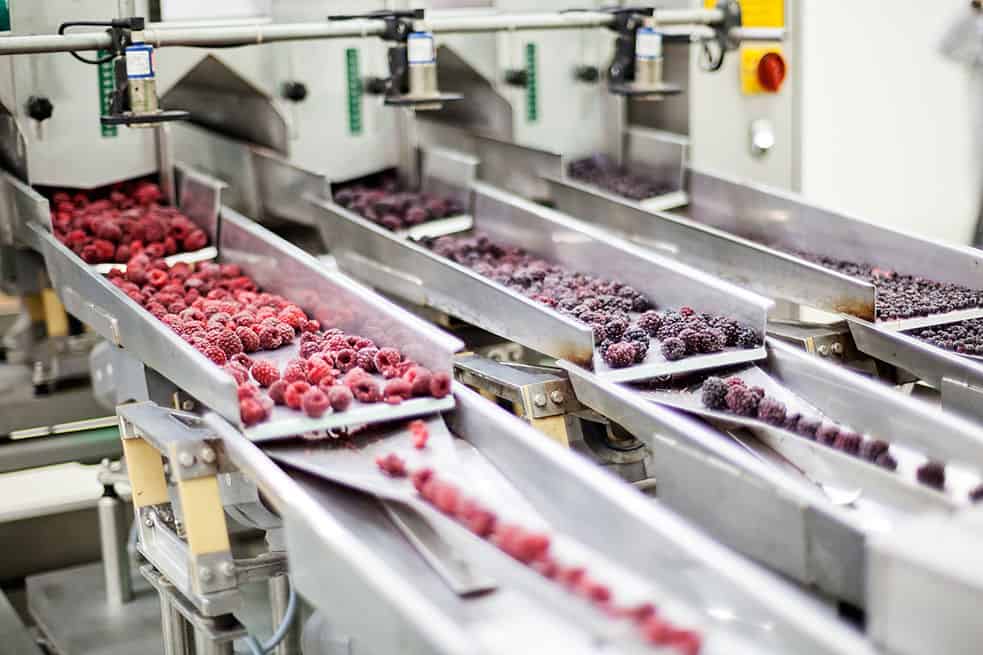
Posted by Sun Coating on | Comments Off on Coating Solutions for IQF (Individually Quick Frozen) Food Processing Equipment
In the high-stakes world of industrial food manufacturing, optimization usually centers around heat. Processing plants meticulously manage baking temperatures and heat-sealing thresholds. However, one of the fastest-growing sectors in the food industry operates at the exact opposite end of the thermometer: Individually Quick Frozen (IQF) processing.
From diced poultry and seafood to delicate berries and farm-fresh vegetables, the global demand for IQF products continues to surge. The reason is simple: IQF technology flash-freezes individual pieces of food rapidly, preventing the formation of large ice crystals within vegetable or animal tissues. This preserves the structural integrity, flavor, and nutritional profile of the product far better than traditional bulk-freezing blocks.
Yet, working at sub-zero temperatures introduces a completely unique set of mechanical and material handling challenges. When moisture-rich food meets sub-zero metal machinery, physical bonding happens in milliseconds.
Standard manufacturing components quickly become plagued by frozen product accumulation, ice dams, and severe friction spikes. To keep these automated, continuous freezing lines moving without frequent emergency shutdowns, specialized surface chemistry is required.
The Sub-Zero Dilemma: How Cryogenic Temperatures Defeat Standard Surfaces
In a standard room-temperature application, stainless steel is the gold standard for hygiene. But inside an industrial blast freezer or cryogenic tunnel, where ambient temperatures regularly plummet between -20°F and -50°F (and even lower in liquid nitrogen systems), stainless steel turns into a liability.
When unfrozen or partially wet food items land on a sub-zero metal conveyor link, freezing grid, or transfer chute, two disruptive phenomena occur instantly:
Adhesive Cryo-Bonding: Surface moisture on the food product acts as an instantaneous, aggressive structural adhesive. The water freezes directly to the microscopic pores and machining grooves of the raw metal substrate. The product no longer slides; it anchors.
Ice Bridging and Damming: As more product flows down the line, subsequent pieces catch on the frozen-down items. This creates a cascading ice bridge, resulting in catastrophic material pile-ups, product bruising, and immediate line stoppages.
The Chemistry of Success: Fluoropolymers at Sub-Zero Temperatures
Overcoming the unique challenges of IQF processing requires specialized high-performance fluoropolymers, including PTFE, FEP, and Teflon PFA coatings.
While these advanced coatings are widely recognized for their high-heat limits in commercial baking, their sub-zero performance is where advanced engineering truly shines.
Maintaining an Ultra-Low Coefficient of Friction
Fluoropolymer coatings feature low surface energy, meaning virtually nothing can adhere permanently to them. For IQF lines, this low surface energy prevents ice and moisture from forming a secure mechanical bond with the underlying equipment. Even at -40°F, the coefficient of friction remains remarkably low, allowing flash-frozen diced meats or wet fruits to slide effortlessly through chutes, vibratory feeders, and transition points.
Cryogenic Flexibility and Thermal Shock Resistance
Unlike standard plastics or paint finishes that turn brittle and fracture when frozen, high-quality fluoropolymers retain their structural flexibility at cryogenic temperatures. Because these coatings possess outstanding thermal stability across a massive operating range, from below -100°F up to 500°F, they can comfortably handle the rapid thermal cycling common in industrial plants.
Critical IQF Machinery Components that Require Coating Optimization
To fully unlock the benefits of high-capacity IQF freezing, specific mechanical stress points throughout the automated line must be engineered with targeted surface properties:
1. Freezing Grids, Tunnels, and Conveyor Belts
Whether your plant utilizes a fluid bed freezer, a spiral freezer, or a straight belt tunnel, the initial point of freeze is the most volatile zone. Wet food products drop directly onto metal links or perforated plates.
Applying an exceptionally durable, FDA-compliant fluoropolymer system makes sure that frozen items lift cleanly off the belt at the discharge end without tearing or leaving behind fragments.
2. Vibratory Feeder Pans and Distribution Chutes
Prior to entering the freezer, product must be evenly distributed across wide beds to prevent clumping. If a feeder pan accumulates a layer of frozen frost, the smooth, micro-vibrations lose their effectiveness, causing the food to bottleneck. A low-friction, moisture-repellent coating preserves consistent flow into the freezing zone.
3. Flighted Incline Conveyors and Diverter Gates
Automated sorting gates and incline steps frequently slam or slide against high-velocity products. These high-motion components require reinforced fluoropolymer systems that couple non-stick properties with robust wear resistance. This balance makes sure the coating withstands both the constant abrasion of frozen items and mechanical friction without wearing down prematurely.
Why the Application Process Dictates Field Longevity
In industrial food production, a coating is only as reliable as the application process behind it.
At Sun Coating Company, our application methods are designed to secure adhesion.
Substrate Preparation: We thoroughly clean and grit-blast raw metal components to build an anchor profile. This microscopic texturing secures a mechanical bond between the metal and the coating system.
Thermal Curing: Utilizing calibrated, industrial ovens, we cure our coatings under exact temperature profiles. This process drives out solvents and optimally forms the fluoropolymer coatings for maximum service life and performance.
Reinforced Wear-Resistant Systems: For heavy-wear food components, we offer advanced, multi-layer reinforced coating systems. By incorporating a matrix of tough, wear-resistant particles, we create a rugged “peaks and valleys” architecture. The non-stick fluoropolymer is shielded from abrasive wear by the tough peaks, which drastically extends the operational lifespan of your machinery.
Engineered to Comply: Total Safety with FDA Regulations
Every coating solution we apply for the food processing sector is fully compliant with FDA regulatory standards for direct food contact. By removing product buildup and ice damming, custom coating solutions help minimize food debris accumulation, making your sanitation cycles faster, more effective, and considerably less reliant on harsh manual scraping.
Ready to Optimize Your IQF Production Line?
As the industrial demand for individually quick frozen foods accelerates, plant efficiency comes down to managing surface friction. Don’t let sub-zero ice buildup, product damage, and frequent maintenance shutdowns freeze your bottom-line profitability.
Partner with an industry leader. Sun Coating Company brings over 60 years of technical expertise as a licensed, innovative industrial applicator. Whether you are an original equipment manufacturer (OEM) designing next-generation freezing tunnels, or a plant manager looking to eliminate a persistent bottleneck on an active packaging or processing line, let us help you find the exact fluoropolymer solution for your operational needs. Contact us today to get started.
Posted by Sun Coating on | Comments Off on The Executive Guide to Industrial PTFE: Properties, Application, and Performance
Have you ever wondered why performance-life varies among industrial protective finishes in demanding mechanical environments?
Polytetrafluoroethylene (PTFE), commonly known by brand names like Teflon™, is the gold standard for high-performance industrial coatings. It can transform ordinary metal components into high-durability assets capable of resisting heat, friction, and chemical corrosion.
What is PTFE? Understanding the “Gold Standard”
For the average person, the name PTFE would be synonymous with “nonstick stuff” used in cookware. However, for an engineer, PTFE can be seen as a material with high stability that is a fluoropolymer having a very high bond strength between the carbon and fluorine atoms.
In the field of polymer chemistry, the carbon-fluorine bond is considered to be one of the strongest bonds in organic chemistry. The fluorine atoms act as a shield that protects the carbon atoms from bonding with any other atom. This gives rise to a surface with low surface energy. For any designer of products, this molecular structure is the key to the two most desired qualities in the mechanical world: low friction and nonstick release. Due to its low surface energy, only very few materials can adhere to it, thus allowing materials to glide off easily and causing no parasitic resistance between components.
Key Industrial Benefits for Engineers
Extreme Lubricity: PTFE has one of the lowest coefficients of friction of any solid material. If your machinery has parts that slide, rotate, or pivot, a PTFE coating allows them to move with minimal resistance. This often eliminates the need for messy liquid lubricants, which can contaminate sensitive environments like food or pharmaceutical lines.
Thermal Stability: PTFE is a thermodynamic outlier. It remains functionally stable from cryogenic temperatures up to a continuous operating temperature of 500°F (260°C). This makes it indispensable for high-heat applications like heat-sealing bars and aerospace engine components.
Chemical Inertia: Due to its molecular shielding, PTFE is virtually unaffected by most acids, bases, salts, and solvents. It prevents “pitting” and galvanic corrosion in harsh chemical processing environments.
Regulatory Compliance: Its inert nature makes it inherently “food safe.” For designers in the food processing or medical device sectors, PTFE makes sure that the coating will not leach chemicals into the product, meeting strict FDA and global safety standards.
The Science of Surface Preparation: Achieving Adhesion
The most crucial stage of the entire coating process is the step which the end-user never gets to see. Simply spraying PTFE onto a surface won’t work as this material, due to its non-stick properties, would simply refuse to adhere to the metal substrate. The life-span of the coating and its performance characteristics depend directly on the bonding strength achieved through surface preparation. To get an effective bond, two procedures are essential: industrial surface cleaning and mechanical surface roughening.
The first procedure entails removing all surface contaminants from the substrate, including thermal degreasing (“burn-off”). Parts with prior use accumulate grease inside microscopic pores of metal substrate; specialists heat these to 750° F and convert harmful substances into ash. Then they proceed with mechanical grit blasting with aluminum oxide to achieve “anchor profile,” which means transforming a smooth surface into a terrain with microscopic mountains and valleys. By adding surface area and mechanical bonding capabilities, the PTFE acquires enough foothold to stay glued to the surface. Otherwise, even a high-quality coating may delaminate and blister prematurely.
Industries Served: Where PTFE Makes the Difference
Based on the high standards maintained by industry leaders like Sun Coating Company, PTFE is essential across several diverse sectors:
Industry
Primary Use Case
Automotive
Coating fasteners, fuel system components, and seat belt mechanisms to prevent squeaks and corrosion.
Food Processing
Bakeware, molds, and mixing vats where “easy release” is required for hygiene and speed.
Aerospace
Protecting engine parts and airframe components from high-altitude temperature swings.
Packaging
Heat-sealer bars and cutting blades that must stay clean and resist adhesive buildup.
Sintering: The Fusion Stage
Once the PTFE is applied (usually via a liquid spray or powder process), it must undergo sintering. Sintering is a carefully controlled baking process whereby the piece is heated in a range of 650 F to 750F.
In the process of sintering, the tiny bits of the polymer become fluid and unite to form an uninterrupted solid layer. At this point, care needs to be taken because if the temperature is not high enough, the layer will fail to gel and stay porous. When the temperature is excessively high, there may be chances of degradation of the polymer. The Sun Coating Company makes use of precisely controlled ovens to make sure that the surface coating crystallizes to give maximum resistance.
Troubleshooting and Maintenance
While industrial PTFE coatings are incredibly durable, they are not indestructible. To get the longest life out of your coated components, engineers should implement the following best practices:
Avoid Abrasive Cleaning: While the coating is tough, cleaning it with wire brushes or harsh abrasives can score the surface. These scores become “trap sites” for debris, eventually reducing the nonstick properties.
Monitor Operating Temperatures: PTFE is rated for 500°F. Exceeding this limit for extended periods causes the material to soften, increasing the wear rate. In extreme overheat scenarios, the polymer can “off-gas,” requiring immediate ventilation.
Check for “Cold Flow”: Under extremely high localized pressure, PTFE can exhibit “creep” or cold flow. Designers should verify that the load-bearing requirements of the part do not exceed the structural limits of the specific PTFE grade used.
Professional Recoating: One of the most sustainable features of PTFE coatings is that they can often be stripped and reapplied, returning it to like-new performance.
Conclusion: Why Expertise Matters
The application of PTFE is a careful blend of science, heat, and know-how. For firms involved in the manufacturing of automobiles, aircraft, and food products, an inadequate coating can cost you much more than simply having to replace a component.
When you select us to apply PTFE to your equipment, you are not merely receiving a “spray job.” Instead, you are providing yourself with a durable surface, able to withstand even the most rigorous environmental conditions. The process from thermal degreasing all the way through the final baking stages is done with longevity in mind.
Are you ready to upgrade your components with high-performance PTFE? Contact Sun Coating Company today to get an expert quote.
Posted by Sun Coating on | Comments Off on Reducing Friction on Metal Components with PTFE and Fluoropolymer Coatings
Metal parts that stick, bind, or wear quickly create problems that ripple through industrial operations. A dye that sticks to molded parts. Fasteners that seize in place. Shafts that wear against bushings. Punches that require increasing force with each cycle. These friction problems slow production, increase equipment damage, and eventually cause failures that shut down operations. Many manufacturers try to solve these issues with oil lubricants or mechanical redesigns.
These solutions often fail because they don’t address the underlying cause: friction between metal surfaces. PTFE and fluoropolymer coatings offer a different approach. By coating metal components with specialized low-friction coatings, you create durable nonstick and dry lubrication surfaces that overcome sticking and wear without ongoing maintenance. Let me explain how these coatings work and why they’re superior to traditional lubrication methods.
The Problem With Metal Friction
When two metal surfaces move against each other, friction causes several problems:
Surfaces wear down from constant contact
Heat builds up from friction
Material transfers from one surface to the other
Galling effect accelerates wear over time
Components lose dimensional accuracy
Equipment performance degrades
Traditional Lubrication Limitations
Oils and greases collect dirt over time
They dry out and lose effectiveness
They require constant reapplication
High-temperature applications cause lubricants to break down
Clean-room environments get contaminated by lubricants
Lubricants migrate to sensitive areas
Common Friction Problems in Manufacturing
Steel dyes in injection molding stick to plastic parts as they cool
Operators must force parts out, requiring increasing force over time
This repeated stress damages both the die and the part
Food processing equipment can’t use oil lubricants due to sanitation requirements
Industrial fasteners seize in threaded holes and become impossible to remove
Cutting out seized fasteners costs time and money
Traditional solutions like better lubricants, more frequent application, or mechanical redesigns address symptoms rather than the root problem: friction itself.
Understanding PTFE Coatings
PTFE stands for polytetrafluoroethylene, the same material used in Teflon non-stick cookware. It belongs to a group of plastics called fluoropolymers, which contain fluorine atoms and are known for their strength and stability. Because of these properties, Teflon PTFE Coating is widely used to reduce friction, prevent corrosion, and improve performance in applications where durability and reliability are critical.
What sets PTFE apart is its molecular structure. Strong fluorine bonds create a surface that resists sticking and produces extremely low friction. While steel sliding against steel has a friction range of about 0.6 to 0.8, PTFE against steel falls between 0.05 and 0.15, making it several times more slippery. When applied as a coating on metal, PTFE combines metal’s durability with a smooth, low-friction surface that allows parts to move easily with less wear.
How PTFE Coatings Solve Industrial Problems
When you coat metal components with PTFE, several problems disappear. Here’s what changes:
PTFE coatings eliminate sticking, allowing materials to slide freely and making part release smoother in molds, dyes, and fasteners. This also lets operators remove parts sooner without damaging tools or components.
Lower friction significantly reduces wear, helping tools, shafts, and assemblies last much longer while maintaining performance. Faster, smoother movement shortens cycle times, keeps equipment running efficiently, and reduces heat buildup and thermal stress.
Because PTFE coatings act as a permanent dry lubricant, maintenance needs drop. There’s no need for oils or greases, which keeps operations cleaner and reduces downtime. Over time, faster production, fewer replacements, and lower maintenance costs reduce the cost per part and improve overall return on investment.
Applications Where PTFE Coatings Excel
PTFE coatings are used in a wide range of industrial settings.
Injection Molding Dyes and Cores
Injection mold dyes experience constant sticking as plastic cools and shrinks around the mold. Coated dyes release parts easily. Operators can remove parts at earlier points in the cooling cycle, reducing cycle time. Dyes last longer because they experience less stress from forced part removal.
Fastener Manufacturing and Assembly
Fasteners can seize in tapped holes, becoming impossible to remove without destruction. Coating the fastener threads with PTFE prevents this problem. Fasteners install and remove smoothly, even after long periods of assembly.
Press Punches and Dyes
Punch tools used in stamping and forming operations experience friction against the workpiece and die cavity. PTFE coating reduces this friction. Punches require less force, last longer, and produce better surface finish on parts.
Food Processing Equipment
Food processing demands sanitary conditions without oil lubricants. PTFE coatings provide dry lubrication without contamination risk. Blades, screws, and rollers in food processing equipment operate more efficiently with PTFE coating.
Release Applications in Manufacturing
Any application where you need parts to release easily benefits from PTFE coating. Release screws, ejector pins, and demolding surfaces all work better when PTFE coated.
High-Temperature Operations
At high temperatures, lubricant oils break down. PTFE maintains its properties up to 500 degrees Fahrenheit. Equipment operating at temperature ranges where lubricants fail still functions well with PTFE coating.
Different Types of PTFE and Fluoropolymer Coatings
Several types of PTFE and fluoropolymer coatings exist, each with different properties and applications.
Pure PTFE Coatings
Provides excellent release properties
Offers low-friction characteristics
Soft coating suitable for specific applications
Works best where the coated part doesn’t experience heavy abrasive wear
Makes coating harder and more resistant to abrasion
Maintains nonstick and low-friction properties
Better for high-wear applications
PFA Coatings
Stands for perfluoroalkoxy
Works in demanding and harsh applications
Better chemical resistance in some cases
Maintains performance at extreme temperatures
FEP Coatings
Stands for fluorinated ethylene propylene
Offers properties similar to PTFE
Flows differently during the cure process
Creates smoother, more uniform coatings
Useful where coating thickness matters
Better for applications requiring surface smoothness
Works well for precision components
Selection Considerations
High-temperature applications benefit from PTFE
Applications with significant wear need filled PTFE
Applications prioritizing release use pure PFA
Cost constraints may dictate coating selection
The application environment affects which coating works best
Consult coating specialists for specific recommendations
Advantages Over Traditional Lubrication
Comparing PTFE coatings to traditional oil and grease lubrication shows clear advantages in many applications.
Maintenance and Reapplication
Oil and grease require constant reapplication every few weeks or months
PTFE coatings are permanent once applied and cured
You don’t need to add lubricant constantly
Reduces scheduled maintenance requirements
Eliminates ongoing lubrication costs
Decreases labor spent on relubrication
Contamination and Dirt Issues
Oil and grease collect dirt over time
Dirt mixed with lubricant creates a grinding paste
This grinding paste accelerates wear dramatically
PTFE coatings don’t collect dirt
They stay clean and effective throughout use
No dirt contamination of the surrounding areas
Migration and Spread
Oil and grease migrate and spread to the surrounding areas
In food processing, this creates contamination problems
Clean rooms become contaminated by lubricant spread
Sensitive electronics get damaged by lubricant migration
PTFE coatings stay in place and don’t migrate
No risk of contamination from coating movement
High-Temperature Performance
Oil and grease break down at elevated temperatures
Many applications exceed lubrication temperature limits
PTFE coatings maintain performance up to 500 degrees Fahrenheit
High-temperature environments work reliably with PTFE
No concern about lubricant breakdown at the temperature
Durability and Limitations
PTFE coatings are durable, but they’re not indestructible. Understanding their limitations helps you apply them appropriately.
Wear Resistance Limitations
PTFE is soft in its pure form
Heavy abrasive wear can wear through pure PTFE coatings
Filled PTFE resists abrasive wear much better
In heavily abraded surfaces, coatings may wear before the base metal
Coating lifespan depends on wear severity
Application selection matters for longevity
Structural Limitations
PTFE cannot be used as a structural coating
Cannot reinforce components experiencing high stress
Coating thickness measured in mils (very thin)
Acts as a surface coating, not a reinforcement layer
Base metal still carries the structural load
PTFE only reduces friction, not strengthens the component
Temperature Limits
Standard PTFE coatings max out at approximately 500 degrees Fahrenheit
Applications regularly exceeding 500 degrees need higher-temperature coatings
Very high-temperature applications may need specialized materials
Exceeding temperature limits causes coating degradation
Plan carefully for thermal requirements
Application Considerations
PTFE coating works best in designed applications
Not suitable for all industrial situations
Selecting the right coating type is critical
Understanding limitations prevents disappointment
PTFE excels at its intended purpose of reducing friction
Perfect application selection leads to excellent results
Implementing PTFE Coatings in Your Operations
If you have friction or sticking problems in your manufacturing, consider PTFE coatings. Identify your specific problems. Do parts stick to dyes or molds? Do fasteners seize? Do shafts wear? Understanding your friction problem guides coating selection.
Start with a pilot application. Coat some of your problem components and test performance. Measure cycle times, wear, and part quality. Pilot projects prove value before committing to coating your entire inventory.
Work with your coating provider to select the right coating type for your application. They can advise whether standard PTFE, filled PTFE, PFA, or FEP is best. For hot plate welding coatings, PTFE helps prevent material buildup on heated surfaces, allowing for cleaner welds, more consistent cycle times, and reduced downtime for maintenance and cleaning.
Plan coating as part of your maintenance cycle. When components wear out or need replacement, coat new ones. This spreads coating costs over time while improving your operation gradually.
Solving Friction and Wear with PTFE Coatings
Friction and sticking on metal components create problems that multiply throughout your operation. Traditional lubrication approaches provide temporary relief but require constant maintenance.
PTFE and fluoropolymer coatings address the root problem by creating permanent, low-friction, nonstick surfaces. Coated components release easily, wear slowly, and maintain performance without ongoing lubrication.
For industrial applications where friction creates costs, lost production time, or quality problems, PTFE coatings deliver measurable returns on investment. They’re tough, durable, and effective.
If you’re struggling with sticking, seizing, or wear on metal components, investigate PTFE coatings. A small coating investment often solves problems that have plagued your operation for years. Contact Sun Coating today to discuss your application challenges and learn how PTFE coatings can improve performance, reduce downtime, and deliver long-term value.
Posted by Sun Coating on | Comments Off on PTFE Teflon Coating Applications for Industrial Automation
Sun Coating has become a trusted leader in industrial coating applications for the automation and manufacturing sectors, known for its expertise, technical precision, and long-standing commitment to product performance. With decades of experience applying PTFE and other advanced fluoropolymer coatings, Sun Coating partners with manufacturers to solve challenges related to friction, wear, temperature, and chemical exposure. Our team understands the rigorous demands of industrial automation and delivers coating solutions that stand up to extreme operating conditions.
From high-volume production to specialized component needs, Sun Coating provides consistent quality, reliable turnaround times, and coating performance that helps manufacturers improve durability, efficiency, and overall product reliability. PTFE stands for polytetrafluoroethylene. Most people know it by the brand name Teflon. This special coating has unique properties that make it valuable in many industries, especially industrial automation and manufacturing.
PTFE coating creates a non-stick surface that resists heat, chemicals, and friction. The material was discovered in 1938 and has been used in countless applications since then. In the industrial automation world, PTFE coatings help parts last longer, perform better, and require less maintenance.
Key Properties of PTFE Coatings
PTFE’s versatility extends to industrial applications as well, with nonstick coatings for tooling and fixturing helping manufacturers reduce friction, prevent material buildup, and improve overall efficiency in production processes.
Understanding why PTFE works so well in industrial automation applications starts with knowing its properties:
Low Friction Coefficient: PTFE has one of the lowest friction coefficients of any solid material. This means parts coated with PTFE slide smoothly against other surfaces with minimal resistance. For industrial automation components, this reduces wear and improves efficiency.
Temperature Resistance: PTFE coatings can withstand temperatures ranging from -200°C to 260°C (-328°F to 500°F). This makes them perfect for components that experience extreme heat in manufacturing environments.
Chemical Resistance: Industrial fluids like oils, solvents, acids, and cleaning agents don’t damage PTFE coatings. The coating remains stable and protective even when exposed to harsh chemicals.
Non-Stick Properties: The non-stick nature of PTFE prevents the buildup of contaminants, dirt, and residues. This keeps parts cleaner and functioning properly for longer periods.
Electrical Insulation: PTFE acts as an excellent electrical insulator. This property is useful for various electrical components in automated systems.
Major Industrial Automation Applications of PTFE Coatings
Robotics and Automated Assembly Systems
Robotic components benefit greatly from PTFE coatings, as these systems require precise, repetitive movements with minimal friction and wear.
Robot Joints and Actuators: PTFE-coated joints move more smoothly and consistently. This reduces friction, heat, and wear. The result is better precision and longer equipment life. Many high-speed robotic systems use PTFE coatings to handle extreme duty cycles.
Bearings and Bushings: Bearings coated with PTFE last longer and need less lubrication. The coating helps these parts handle high loads while maintaining smooth operation throughout continuous production runs.
Linear Guides and Rails: PTFE coatings on guide rails reduce sticking and wear. This helps maintain proper positioning accuracy and extends the life of linear motion systems.
Conveyor and Material Handling Systems
Material handling equipment contains many parts that benefit from PTFE coatings, especially because these components are constantly exposed to friction, pressure changes, and harsh operating conditions that demand long-lasting protection.
Conveyor Rollers and Idlers: PTFE coatings prevent material buildup on rollers. Clean rollers operate more efficiently, reducing downtime and maintenance. The coating also protects against corrosion from environmental exposure.
Chain and Belt Components: PTFE-coated chain links and belt surfaces resist wear from constant movement and loading. This extends component life and maintains consistent operation.
Chutes and Slides: Interior surfaces of material chutes can be coated with PTFE to reduce friction and prevent material sticking. This helps products flow smoothly through handling systems.
Hydraulic and Pneumatic Systems
Fluid power systems operate under extreme pressure and temperature, making them one of the most demanding areas of industrial automation and a prime candidate for the added protection PTFE coatings provide. PTFE coatings help these critical components perform reliably.
Hydraulic Pistons and Cylinder Rods: PTFE coatings on pistons allow smooth movement within cylinders. This helps maintain consistent system performance and reduces seal wear. Cylinder rods also benefit from PTFE coatings, preventing scoring and extending service life.
Pneumatic Valves and Actuators: PTFE coatings on valve components reduce friction and prevent sticking, maintaining precise control throughout the system’s operation.
Gearing and Power Transmission
Power transmission systems contain multiple moving parts that generate friction and heat during operation, making PTFE coatings essential for efficient performance. PTFE-coated gears operate more smoothly and quietly by reducing the friction that causes gear wear and heat buildup, while drive shafts with PTFE coatings maintain smooth rotation and resist contamination.
Coupling components utilize PTFE coatings to maintain efficient power transfer, which enhances system reliability and extends component life. Additionally, PTFE coatings on universal joints reduce friction and protect against contamination, helping to maintain smooth power transmission throughout the system.
Tooling and Fixturing
Manufacturing tooling and fixtures experience constant use and stress throughout their operation, making PTFE coatings valuable for smooth functionality and extended life. PTFE-coated mold surfaces release parts cleanly without sticking, reducing cycle times and improving product quality while minimizing the need for release agents.
Clamps and holding fixtures benefit from PTFE coatings that reduce friction during part loading and unloading, preventing damage to finished surfaces while maintaining secure holding force. Indexing tables and rotary systems with PTFE coatings resist wear and maintain precise positioning accuracy significantly longer than uncoated alternatives.
Additional PTFE Coating Benefits & Applications
Category
Component
PTFE Coating Benefits
Specific Applications
Electrical and Electronic Components
Wire Insulation
Protects wiring from heat, chemicals, and abrasion
High-temperature areas in control panels and machinery
Electrical and Electronic Components
Sensors
Protects sensor housings from corrosion and contamination; provides electrical insulation
Harsh environment applications throughout manufacturing facilities
Electrical and Electronic Components
Connectors and Terminals
Prevents corrosion; maintains good electrical contact
Improves the reliability of control systems
Processing Equipment
Mixing and Blending Components
Creates a smooth, non-stick surface; resists chemical attack
Makes cleaning easier; maintains equipment performance
Processing Equipment
Pump Components
Reduces friction; prevents chemical corrosion
Chemical processing and fluid transfer systems
Processing Equipment
Valve Seats and Stems
Enables smooth operation without binding; resists chemical exposure
Process control and flow regulation applications
Structural Components
Fasteners and Hardware
Resists corrosion and seizing
Makes maintenance and repairs easier; bolts, nuts, and hardware
Structural Components
Mounting Brackets and Supports
Reduces friction during adjustment; prevents galvanic corrosion
Modular equipment mounting and positioning systems
Benefits of PTFE Coatings in Industrial Automation Applications
Reduced Friction and Wear: The primary benefit of PTFE coatings is friction reduction. Lower friction means less wear on moving parts. Components last longer and maintain their performance characteristics throughout their service life.
Improved Energy Efficiency: Reduced friction in motion systems and power transmission components means equipment uses less energy to overcome resistance. This translates directly to lower operating costs. Even small reductions in friction can add up to measurable improvements in energy consumption.
Extended Component Life: PTFE coatings protect parts from wear, corrosion, and contamination. Coated components often last significantly longer than uncoated alternatives. This reduces replacement costs and downtime.
Lower Maintenance Requirements: Parts with PTFE coatings often need less frequent maintenance. The coatings resist contamination buildup and maintain their lubricity. This means fewer service intervals and lower maintenance costs.
Better Performance in Extreme Conditions: PTFE coatings maintain their properties across a wide temperature range. They continue protecting components whether equipment operates in extreme cold or intense heat.
Increased Productivity: When automation components operate more efficiently with less friction, systems run faster and more reliably. This can lead to higher throughput and reduced cycle times.
Quieter Operation: PTFE coatings reduce friction noise in many industrial systems. This contributes to a quieter, more comfortable working environment.
Application Methods for PTFE Coatings
Several methods exist for applying PTFE coatings to industrial automation parts.
Spray Coating: Liquid PTFE dispersions can be sprayed onto parts, then cured at high temperature. This method works well for complex shapes and large surfaces.
Dip Coating: Parts can be dipped into PTFE coating solutions. This creates uniform coating thickness and works well for smaller components.
Co-Processing: Some parts have PTFE mixed into their base material during manufacturing. This creates components with PTFE properties throughout their structure, not just on the surface.
Considerations for Using PTFE Coatings
While PTFE coatings offer many benefits, there are factors to consider.
Cost: PTFE coating adds to manufacturing costs. However, the long-term benefits often justify the initial investment. Parts last longer and perform better, which can reduce total lifecycle costs.
Application Complexity: Proper PTFE coating requires specialized equipment and expertise. Surface preparation is critical for coating adhesion. Parts must be thoroughly cleaned and sometimes roughened before coating.
Thickness Limitation: PTFE coatings work best when applied in thin layers. Thick coatings may not adhere properly or may crack under stress. Typical coating thickness ranges from 25 to 50 microns.
Environmental Factors: PTFE manufacturing and application must follow environmental regulations. Proper ventilation and waste handling are important during the coating process.
Future Trends in Industrial Automation PTFE Applications
The use of PTFE coatings in industrial automation applications continues to expand as manufacturers search for materials that provide better performance, increased efficiency, and longer component life in increasingly complex modern systems. PTFE technology is growing into new applications and improving through continuous research and material innovation as engineering demands increase.
Emerging manufacturing techniques are also improving demolding SMC for EV battery trays, and advances in coating technologies are helping streamline the process, reduce material waste, and protect delicate components during production.
Smart Manufacturing Systems: Industry 4.0 and smart factory components have unique requirements. PTFE coatings are finding new applications in precision sensors, IoT devices, and automated quality control equipment. The electrical insulation properties of PTFE make it valuable for these sensitive electronic components.
Advanced Coating Formulations: Researchers are developing improved PTFE coating formulations. These include blends with other materials to enhance specific properties. Some new coatings offer even lower friction or better wear resistance.
Sustainable Manufacturing: The industrial automation sector is focusing on sustainability. New PTFE coating processes aim to reduce environmental impact while maintaining performance benefits.
The Growing Importance of PTFE in Industrial Automation
PTFE Teflon coatings play a vital role in modern industrial automation and manufacturing. From robotic systems to material handling equipment, these coatings improve performance, extend component life, and reduce maintenance needs.
The unique properties of PTFE make it ideal for the demanding conditions in automated production environments. Low friction, high temperature resistance, and chemical stability help industrial components perform better and last longer.
As automation technology advances, PTFE coatings will continue to evolve. New applications in smart manufacturing and improved coating formulations will expand the role of PTFE in industrial automation.
For manufacturers, the investment in PTFE coatings often pays dividends through improved product quality and customer satisfaction. For facility operators, PTFE-coated components mean better performance, lower maintenance costs, and longer equipment life.
Understanding PTFE coating applications helps everyone appreciate the technology that makes modern manufacturing reliable, efficient, and durable. These invisible coatings work behind the scenes to improve every aspect of industrial automation performance. Discover how Sun Coating can help your industrial components achieve maximum performance and durability. Contact us today to learn about our advanced PTFE coating solutions.
Manage Consent
To provide the best experiences, we use technologies like cookies to store and/or access device information. Consenting to these technologies will allow us to process data such as browsing behavior or unique IDs on this site. Not consenting or withdrawing consent, may adversely affect certain features and functions.
Functional Always active
The technical storage or access is strictly necessary for the legitimate purpose of enabling the use of a specific service explicitly requested by the subscriber or user, or for the sole purpose of carrying out the transmission of a communication over an electronic communications network.
Preferences
The technical storage or access is necessary for the legitimate purpose of storing preferences that are not requested by the subscriber or user.
Statistics
The technical storage or access that is used exclusively for statistical purposes.The technical storage or access that is used exclusively for anonymous statistical purposes. Without a subpoena, voluntary compliance on the part of your Internet Service Provider, or additional records from a third party, information stored or retrieved for this purpose alone cannot usually be used to identify you.
Marketing
The technical storage or access is required to create user profiles to send advertising, or to track the user on a website or across several websites for similar marketing purposes.