

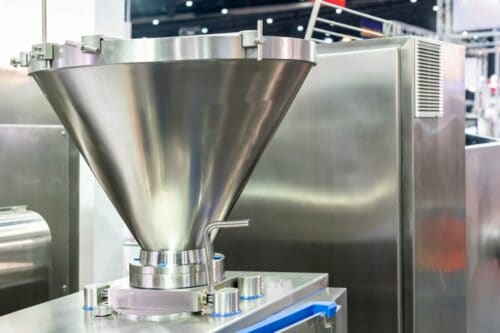
A bridged hopper can idle a blending line for hours, and the fix is rarely more hammering. Advanced dry film lubricant coating solutions applied by Sun Coating Company to the internal surfaces of hoppers, chutes, and rotary valve rotors reduce wall friction far enough that most cohesive powders keep moving under their own weight. In pharmaceutical and chemical bulk processing, partnering with Sun Coating Company for targeted surface treatments often eliminates the arching, rat-holing, and ledge buildup that operators otherwise manage with mallets and poke rods.
What Actually Causes a Powder to Bridge
Bridging happens when the cohesive strength of a powder exceeds the stress pulling it through an outlet, forming a stable arch across the opening. Rat-holing is the related failure mode: material flows through a narrow central channel while the surrounding product sits packed against the vessel wall. Both conditions trace back to the same handful of variables.
- Wall friction angle between the powder and the vessel surface, which determines whether flow is mass flow or funnel flow
- Particle size and shape, with fines under 50 microns behaving far more cohesively than free-flowing granules
- Moisture pickup from ambient humidity, which creates liquid bridges between adjacent particles
- Consolidation time, since powder left static overnight in a hopper gains measurable strength before the next shift starts
- Electrostatic charge generated by pneumatic conveying, which pins fines to grounded steel walls
Stainless steel in a standard 2B mill finish has a relatively high wall friction angle with most organic powders, which is why clean, polished vessels still bridge. Lowering that angle is the lever that coatings pull on.
Where Buildup Starts on Bulk Handling Equipment
Material rarely sticks everywhere at once. Operators usually find the same trouble spots across chemical and pharmaceutical plants, and those spots make the best candidates for surface treatment.
- Hopper cones and transition sections, especially where the wall angle falls below 65 degrees from horizontal
- Rotary airlock pockets, where compaction against the rotor tips packs product into a hard rind
- Chute liners and diverter gates, where impact and sliding contact grind fines into the surface profile
- Screw conveyor flights and troughs, which collect a lubricated film of magnesium stearate or similar excipients
- Blender ribbons, paddles, and discharge valves, where residue drives up cleaning validation time
How Dry Film Lubricant Coating Changes the Equation
A dry film lubricant is a bonded solid lubricant, commonly PTFE, molybdenum disulfide, or a blend of both in a resin binder, that cures into a thin layer with a very low coefficient of friction. Values typically land between 0.04 and 0.15 against steel, compared with roughly 0.4 or higher for untreated stainless. That reduction changes the critical outlet dimension required for reliable flow, and in many retrofits it converts a funnel flow hopper into something much closer to mass flow without any structural change to the cone.
The lubricant is dry, so it does not migrate into product, attract fines the way an oil film would, or wash off during a clean-in-place cycle. Film thickness is the other advantage. Most bonded dry film lubricants cure between 0.0002 and 0.0005 inches, which keeps tight running clearances on rotary valves and gate seals intact.
Matching the Coating to the Powder and the Equipment
No single chemistry suits every vessel. Selection depends on product contact requirements, service temperature, abrasion load, and whether the part moves against another part.
- PTFE-based dry film lubricants: lowest friction, excellent release from sticky organics, service to roughly 500 degrees Fahrenheit
- Molybdenum disulfide dry film lubricants, often specified to MIL-PRF-46010: higher load capacity for rotary valve rotors, vane gates, and sliding mechanical contact
- FEP and PFA fluoropolymer linings: thicker builds from 0.001 to 0.003 inches, better for corrosive slurries and surfaces that see constant abrasion
- Electroless nickel with co-deposited PTFE: adds hardness around 50 HRC for abrasive mineral powders while keeping release properties
- Ceramic-reinforced fluoropolymers: used on chute liners handling angular, high-velocity material
For a hopper handling a hygroscopic API, release and cleanability dominate the decision. For a rotary airlock passing titanium dioxide at 15 rotations per minute, wear resistance carries more weight than the absolute friction number.
Regulatory and Cleaning Requirements in Pharmaceutical Plants
Product contact surfaces in drug and food manufacturing need documentation, not just performance. Many fluoropolymer and dry film systems are formulated with resins listed under 21 CFR Part 175 for food contact, and manufacturers can supply compliance letters for the specific product code applied. Validation teams generally ask for three things before approving a coated vessel.
- Written confirmation of the resin’s food or drug contact status, tied to the exact coating designation
- Extractables and leachables data, or a USP Class VI biocompatibility statement where the application calls for it
- Compatibility data for the cleaning agents in use, including caustic solutions, 70 percent IPA, and steam exposure during CIP or SIP cycles
Residue reduction has a secondary safety benefit. Accumulated combustible dust inside and around processing equipment remains a recognized explosion hazard, and OSHA guidance on combustible dust treats housekeeping and accumulation control as a primary mitigation step.
Surface Preparation Determines Service Life
Coating failure almost always traces back to preparation rather than the chemistry itself. Properly processed parts are degreased, abrasive blasted to a controlled profile, usually 1.5 to 3 mils for fluoropolymers and lighter for thin dry film lubricants, then coated and oven cured within a defined window to avoid flash rust or handling contamination. Cure temperatures run between 300 and 400 degrees Fahrenheit for most bonded dry film lubricants, and up to 750 degrees Fahrenheit for sintered PTFE systems.
Vessel geometry matters during application. Hopper cones, valve bodies, and conveyor troughs need line-of-sight access for consistent film build, so large fabrications are often coated before final assembly. Expected service life in clean powder duty commonly runs two to five years, while abrasive mineral service may require recoating annually.
Quantifying the Return Before Approving the Project
Plants that track the problem usually find the cost sits in places other than the obvious downtime. Yield loss from product left clinging inside hoppers after a changeover can reach several percent on small, high-value batches. Cleaning labor between campaigns often consumes four to eight hours per vessel, and every hammer strike on a bridged cone deforms the wall slightly, creating a new catch point for the next batch.
A useful baseline is simple: log the number of manual interventions per shift, the minutes lost to each one, and the weight of material discarded at cleanout. Those three figures give engineering a defensible payback calculation, and in most powder plants the coating cost is recovered within one to three quarters.
Frequently Asked Questions
Will a Dry Film Lubricant Coating Change My Rotary Valve Clearances?
A bonded dry film lubricant adds roughly 0.0002 to 0.0005 inches per surface, which is small enough that most rotary valves run without reclearancing. Tolerances should still be reviewed before coating, since valves set at 0.003 inch rotor-to-housing clearance leave less room than typical designs.
How Long Does the Coating Last in Daily Powder Service?
Expect two to five years on hopper walls and chutes handling non-abrasive organic powders, and closer to twelve to eighteen months on rotor tips or high-impact chute sections. Wear is driven mainly by particle hardness and sliding velocity rather than by total throughput.
Can Coating Alone Fix a Hopper That Bridges Every Batch?
Coating resolves most bridging caused by wall friction, but it cannot correct an outlet that is physically undersized for the powder’s arching dimension. A hopper discharging a cohesive powder through a six-inch opening may need both a lower friction surface and a larger outlet or flow aid.
Is the Coating Acceptable for Product Contact Surfaces?
Many PTFE and FEP systems use resins listed for food contact under 21 CFR 175.300, and suppliers issue compliance documentation for the specific product applied. Pharmaceutical users often request USP Class VI data as well, which is available for a narrower set of coating materials.
Does the Coating Survive Clean-in-Place and Steam Cycles?
Fluoropolymer coatings handle caustic CIP solutions and steam at 250 to 300 degrees Fahrenheit without degrading, provided the cure was complete. Abrasive mechanical scrubbing is the bigger risk, so written cleaning procedures should specify non-abrasive tools.
Talk to Sun Coating About Your Powder Handling Equipment
Sun Coating Company applies dry film lubricants, fluoropolymers, and engineered release coatings to hoppers, chutes, rotary valves, and conveyor components for chemical and pharmaceutical processors. Contact Sun Coating Company with your part drawings, powder characteristics, and cleaning protocol, and our team will recommend a coating system complete with all supporting compliance documentation.